
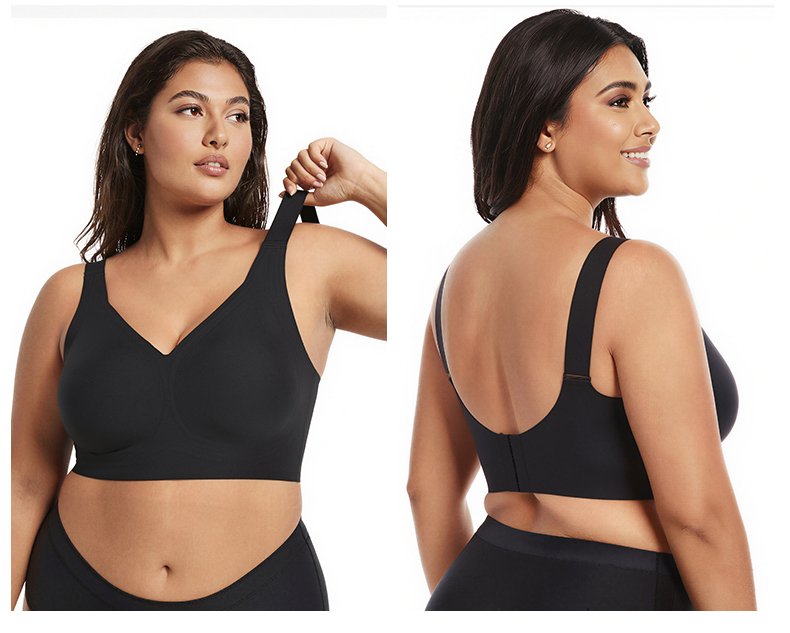
A bra size label should point to a defined supplier measurement sheet, not replace it. Before approving a bulk specification, connect the item, size label and sheet revision, then agree the garment points and conditions used for observation. Record declared values separately from sample measurements. An S-5XL listing alone does not establish body-size equivalence or wearer suitability.
Begin with the supplier’s label, without inventing a conversion
The Jianliang DV12 product page lists S-5XL. Treat those characters as the supplier’s commercial labels until a governing size specification is supplied. Do not convert them into a different brand’s labels or assign a wearer body range from the product photograph. A buyer comparing wholesale plus size bras needs an attributable specification for the exact offer, rather than a familiar label that appears to mean the same thing elsewhere.
Create one mapping row for each requested label. Include the product reference, the label exactly as received and the document that defines it. If the response combines several garment versions, ask which item and appearance references the document covers. A supplier’s answer can be recorded as confirmed coverage, a proposed different sheet or an unresolved relationship. Those statuses make a gap visible without deciding it on the supplier’s behalf.
Name garment points with a marked sketch
A measurement name is useful only when both parties understand its endpoints. For example, a buyer can request a sketch showing where the supplier measures an underband segment or a strap reference length. Ask for the actual points to be marked and the measurement path to be described. These are requests for a method, not claims that a particular measurement is already provided for DV12.
Front and rear catalogue photographs can help people identify an area, but they do not show a controlled measurement setup. A photograph worn by a model is especially unsuitable for deriving relaxed garment dimensions. Use an annotated supplier drawing or an identified sample record for the measurement reference. Keep that reference distinct from a consumer body-measurement guide, which answers a different question and requires its own evidence.
Record conditions before comparing numbers
Do not supply a tolerance because a spreadsheet has an empty tolerance cell. Request the supplier’s proposed basis and agree the final criterion through the appropriate purchasing process. Similarly, do not label a dimension as stretched unless the applied condition is defined. Different closures or strap adjustments can change the setup, so a number recorded without its condition may not be comparable with a later observation.
Record field | Question for the supplier | Buyer observation field
Item and size label | Which DV12 version and label does this sheet define? | Record the same sample and label
Point and path | Where are the start, finish and measurement path? | Use the acknowledged marked points
Garment state | What closure position, adjustment and applied condition are specified? | State what was actually used
Units and revision | Which unit and dated document revision govern? | Keep those units and revision visible
Acceptance basis | What values and criteria are proposed for agreement? | Separate measured result from acceptance decision
Separate declared specifications from observed sample results
Keep the supplier’s declared value in one column and the buyer’s sample observation in another. Add the sample identifier, observation date and method reference beside the latter. This preserves what each number means. Copying the declared value into a sample-result cell would give the appearance of an inspection that never took place; leaving the result blank is the correct choice until an observation is made.
If the two values differ, first check that the item, size label, endpoints, units and garment state match. Record any remaining difference and request clarification. Do not average unlike measurements or silently overwrite the supplier’s specification with a single observation. The response may identify a method mismatch, a different sample version or a proposed change. Keep the evidence for whichever explanation is actually acknowledged.
Control the document that reaches purchasing and receiving
Once the sheet is agreed, save its dated revision with the offer and sample decision. The purchase documentation should identify that revision, rather than link only to a webpage that may change. Retain the original file and record any later replacement explicitly. An approval for one sample does not automatically establish the grading or availability of all the other listed labels.
Provide the receiving team with the item-to-sheet mapping and the method reference they will need. Ask them to identify the delivered labels before comparing measurements. If a label, document or version cannot be matched, hold that comparison for clarification instead of borrowing dimensions from a visually similar garment. This keeps a sourcing record useful through later ordering and receiving steps without offering personal fit advice.
A focused request for the next supplier reply
Send these questions through the actual product enquiry or contact page below. The requested output is a usable specification record. It does not establish comfort, lifting, health benefits, fabric composition or suitability for any individual wearer, and it does not turn a catalogue size chart into an independently verified result.
• Request the governing measurement sheet for the exact DV12 version and each required supplier label.
• Ask for marked garment endpoints, measurement paths, units and closure or adjustment conditions.
• Keep declared values, observed sample values and acceptance decisions in separate fields.
• Identify the approved document revision in purchasing and receiving records; leave missing evidence unresolved.
Frequently asked questions
Is S-5XL a complete garment specification?
No. It is the range of supplier labels shown on the DV12 page. Request the document that defines the relevant garment measurements and the versions it covers.
Can the pictures be used to calculate a band or strap length?
No. The catalogue views do not supply a controlled measurement setup. Ask for marked endpoints and an identified drawing or sample measurement record.
Should the buyer fill in an assumed tolerance?
No. Request the proposed acceptance basis and obtain agreement. A blank field must not become an invented technical requirement.
Does a measurement-sheet approval confirm body fit?
No. It controls garment specification and observation methods. Wearer sizing and suitability require a separate evaluation and cannot be inferred from this record.
Product and contact references
https://jianliangbra.com/product/2-large-size-lifting-bra/
https://jianliangbra.com/products/?product_filter=plus-size-bra
https://jianliangbra.com/contact/
https://jianliangbra.com/blog/